


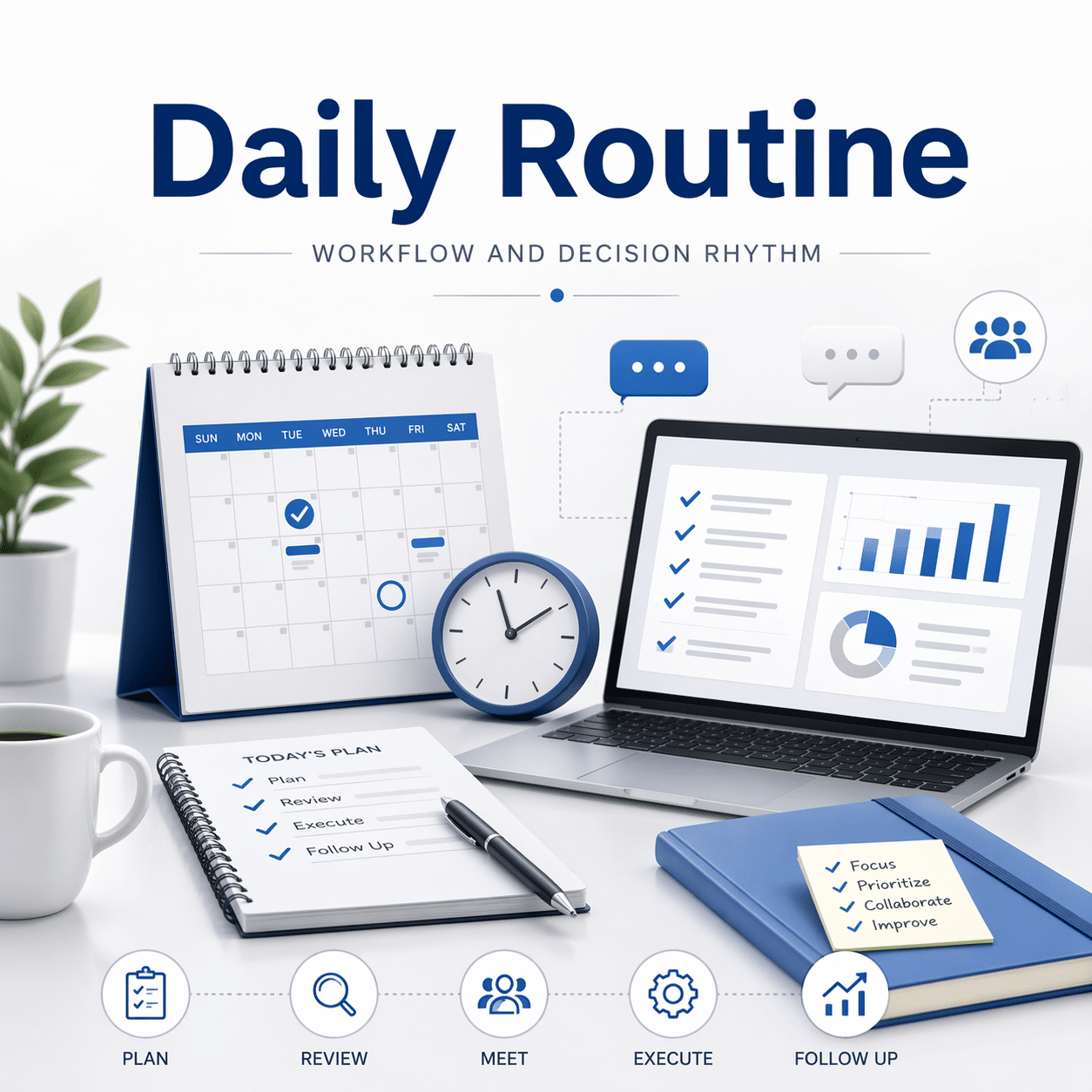
Daily Routine of a CEO
Discover the daily routine of a CEO in an industrial company through Victor, Chief Executive Officer of NorthBridge Components. This page shows how executive priorities, operational reviews, cross-functional decisions, and leadership alignment shape the rhythm of a typical working day.
Description
What does a CEO do during a typical day?
Victor, Chief Executive Officer of NorthBridge Components, works at the intersection of strategy, operations, and executive coordination. His daily routine is not built around isolated tasks, but around priorities that affect the company as a whole. He reviews the most sensitive issues first, supports alignment between departments, and makes sure the business stays focused on measurable objectives.
Starting the day with executive priorities
Victor usually begins the day by reviewing the points that may influence business stability and performance. These include supply risks, production issues, customer impact, financial exposure, staffing concerns, and ongoing decisions that require executive arbitration. He prefers concise updates and expects department leaders to bring facts, risks, and action options clearly.
His role is not to go into every operational detail. Instead, he makes sure the company starts the day with the right priorities already identified and understood. This first review helps him set the tone for the day: structured, clear, and aligned with business objectives.
Managing cross-functional decisions
A large part of Victor’s routine consists of handling issues that sit between departments. Manufacturing, supply chain, finance, IT, and customer-facing teams do not always move at the same speed or with the same priorities. Victor’s role is to reduce friction, clarify decision ownership, and reconnect each discussion to company-level performance.
When a shortage risk appears, he wants to understand the service impact and the decision needed. When costs increase, he wants to know whether the effect is temporary or structural. When departments disagree, he slows the discussion down, asks for measurable facts, and helps the leadership team move toward a clear direction.
Daily exchanges with other leaders
Victor regularly interacts with department heads such as James, Supply Chain Director, or Owen, Finance Director. These exchanges are short, focused, and decision-oriented. He does not use meetings to create authority. He uses them to create alignment.
For example, if the supply chain team raises a material shortage risk, Victor immediately connects the issue to production continuity and customer service. If finance highlights an exposure on margin or cash, he reframes the situation as a business priority and asks for structured decision options. His daily routine is built around this constant movement between facts, risks, and action.
Reviewing performance with operational reality in mind
Victor reviews indicators frequently, but he does not rely on dashboards alone. He pays close attention to the gap that may exist between reporting and operational reality. A stable KPI does not always mean a stable situation. Inventory may look acceptable while parameters are drifting. A project may seem on track while responsibilities remain unclear. His routine therefore combines data review with management judgment.
This is why he values managers who raise issues early, explain them clearly, and propose realistic corrective actions. For Victor, performance is not only about numbers. It is about whether the organization stays capable of executing reliably.
The weekly rhythm behind the daily routine
Beyond the daily rhythm, Victor also works through a weekly cycle. Early in the week, he focuses on priorities and risks. In the middle of the week, he reviews progress and unresolved tensions. Toward the end of the week, he gives more attention to structural questions such as organization, investments, leadership priorities, and topics that may require Board-level visibility.
This weekly logic helps him keep the right balance between short-term execution and long-term direction. It also prevents the CEO role from becoming either too abstract or too absorbed by operational urgency.
Why this routine matters
Victor’s routine makes the CEO role more concrete. It shows that executive leadership in an industrial company is not limited to vision or representation. It is a daily discipline of alignment, review, decision-making, and accountability. Through Victor, visitors can better understand how a CEO supports stability, resolves cross-functional tensions, and keeps NorthBridge Components moving in one direction.
Additional information
| Department | CEO |
|---|---|
| Level | CEO |
| Publication |

